INSPIRATION — DISPATCH 02
What Zaha Hadid Taught Me About Concrete That Moves
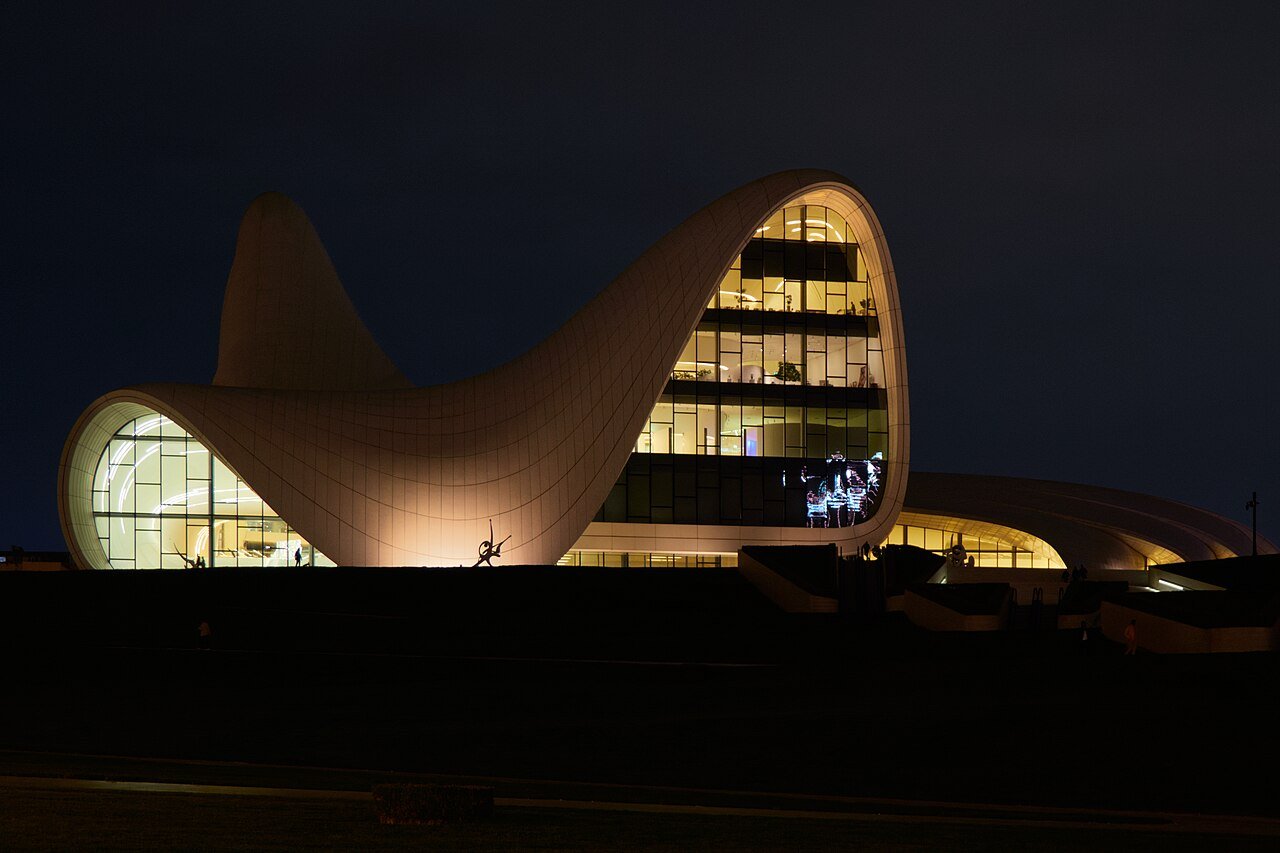
Heydar Aliyev Center, Baku. Zaha Hadid Architects, 2012. Public domain image, Wikimedia Commons.
The first brutalist building I ever stood in front of did not have a name yet, not for me. I was a boy, my uncle had parked near Scampia for some reason I no longer remember, and above the car there were three concrete towers shaped like sails, each one wide enough to swallow the sky behind it. I remember the quiet more than anything. Traffic noise seemed to stop at the base of the towers, as if the concrete itself were heavy enough to absorb sound. I did not know the word brutalism. I only knew that something built by human hands had decided not to apologise for the size of the shadow it cast.
Vele di Scampia has spent forty years being talked about instead of looked at. For a long time it was shorthand for everything modernist housing was supposed to fix and did not: overcrowding, isolation, a district that became a byword for organised crime long before it became a subject for photographers. Critics still argue whether the failure belongs to the architecture, Franz Di Salvo’s triangular sails, or to everything that was never built around it, the schools, the transport, the promises that came with the plan and were never kept. I did not carry that argument as a child. I only had the shape, and the size, and the fact that nobody around me seemed to think it was strange that a house could look like a wave.
A Name For Something I Already Felt
I found Zaha Hadid’s name years later, through photography rather than through architecture, and the recognition was almost embarrassing. Long before I had read a word she wrote, I had already decided, looking at Di Salvo’s towers, that a building was allowed to take up more space and more silence than its neighbours if the shape demanded it. Hadid had the same instinct, except she had the vocabulary and the platform to argue it properly. Writing early in her career, in 1982, she rejected the idea that architects were simply borrowing shapes from a catalogue, and argued that the profession carried what she called “the basic principles of liberation,” the responsibility to let a building claim its ground rather than apologise for it. Reading that felt less like discovering a new idea and more like finding a name for a feeling I had already been carrying around Naples without knowing what to call it.
Straight Lines, Borrowed Curves
Most of what humans build is a straight line pretending to be a decision. Grids, right angles, flat roofs, the whole vocabulary of a species that likes to know exactly where a room ends. Nature rarely works that way. Coastlines curve, hills curve, rivers curve, and so does almost everything that grows rather than gets built. What drew me to Hadid’s later work, the swooping roofs and folded skins, was that she refused to pick a side. A building like the Heydar Aliyev Center is still obviously engineered, still obviously a human decision about where a wall goes, but the language it borrows is the coastline’s, not the drafting table’s. When I photograph a brutalist structure now I am usually looking for that same argument happening inside one frame: a hard, human, deliberate edge set against something the land is doing on its own, whether that is a slope, a treeline, or a sky that will not hold still for the shot.
The Ground Beneath The Argument
I used not to think about the ground a building sits on as part of the subject. I thought about the building. That changed once I started paying attention to how differently the towers at Scampia and a project like Hadid’s sit on their sites. The Vele were dropped onto flat reclaimed land with almost no negotiation with the terrain at all, which is part of why they read as so total, so uncompromising, from every angle. A building that refuses the topography around it has to justify its own scale entirely on its own terms. Hadid’s later buildings do the opposite. They read the slope of the site, the direction the wind comes from, the way water already wants to move across a piece of land, then bend the structure to agree with it rather than override it. Now, before I take a single photograph of a building, I try to walk the ground around it first, sometimes for longer than I spend photographing the structure itself, because the topography usually tells me which of those two arguments the architect was making, and that tells me where to stand.
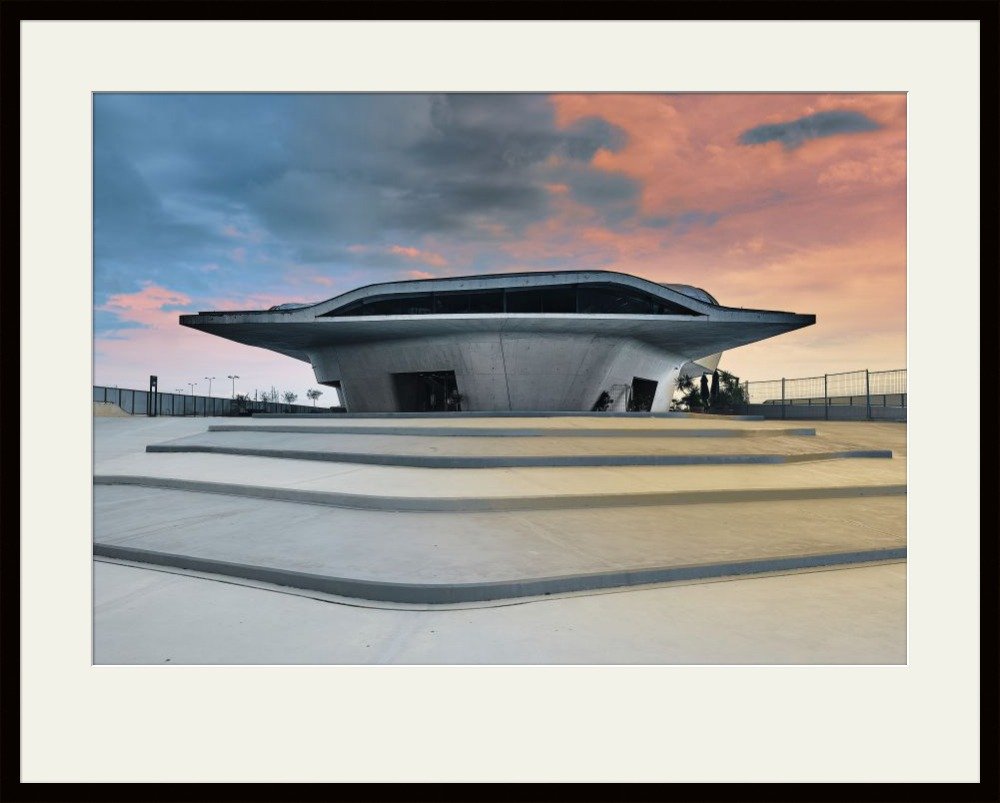
The detail that still surprises me is that Hadid was commissioned, back in 2000, to design a maritime terminal in Salerno, on the same stretch of coast I grew up looking at from the other direction. It was one of her last projects, completed only after her death in 2016, an oyster shaped concrete shell that lifts off the quay the way the Vele never allowed themselves to. Standing in front of it years after Scampia felt like closing a loop I had not known was open, the same argument about how much of the land a building is allowed to claim, made twice, forty kilometres and several decades apart, by two very different structures answering the same question in opposite directions.
I do not have a tidy answer to any of this, and I am not sure I want one. Does a building earn the right to take up more silence than its neighbours simply because its form demands it, or is that just architecture’s version of refusing to apologise. Is a curve borrowed from a coastline still a radical gesture once it is cast in concrete and fenced off behind a security gate. When a housing estate and a museum make the same formal argument, why does one get remembered as a failure and the other as a masterpiece. I photograph these buildings because I have better questions than answers, and I would rather sit with people who want to argue about it than with people who already agree with me.
Beyond The Words
This dispatch started as a photograph.
See the project this piece grew out of, and the rest of the body of work around it.
Working photographer based in London. Prints produced to museum standard.
Ships worldwide to 50+ countries. Returns handled personally, wherever you are.